








1958 Silver Quarter Value: When the Metal Matters and When It Does Not
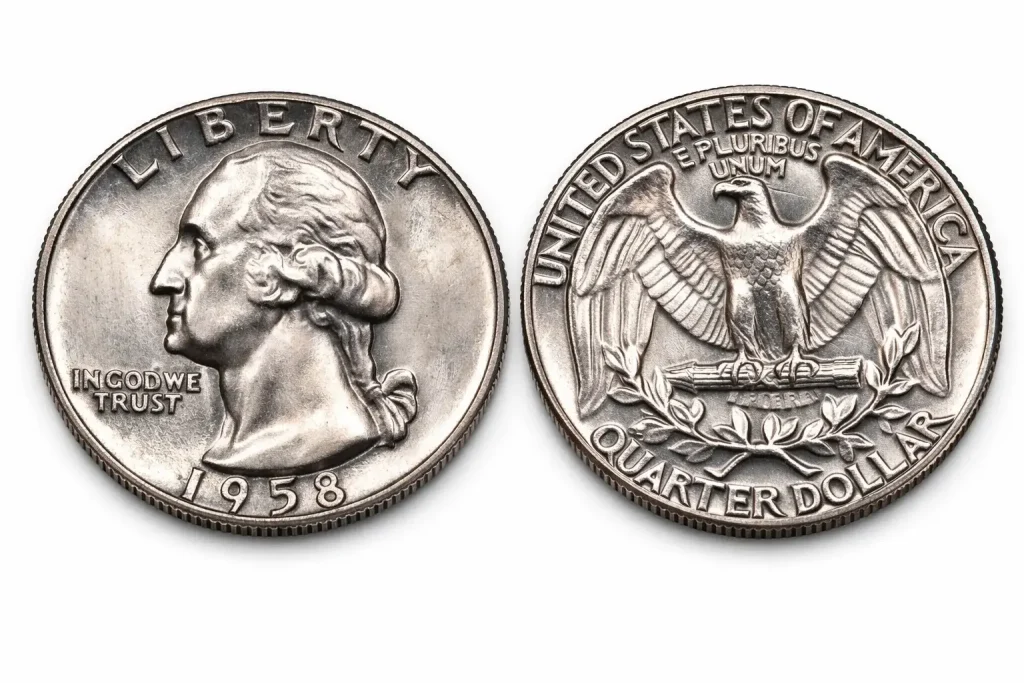
The 1958 silver quarter value starts with silver, but it does not end there. Every 1958 Washington quarter is a 90% silver coin. That gives the date a built-in floor. Yet the market does not price every piece the same way. A worn quarter, a bright Mint State coin, and a proof with deep contrast belong to different value tiers.
That is what makes this date useful for collectors. It shows a simple rule. Silver matters first. Grade, strike, finish, and variety matter later. On some coins, the metal explains most of the value. On others, the premium has little to do with bullion and much more to do with quality.
What Is a 1958 Silver Quarter?
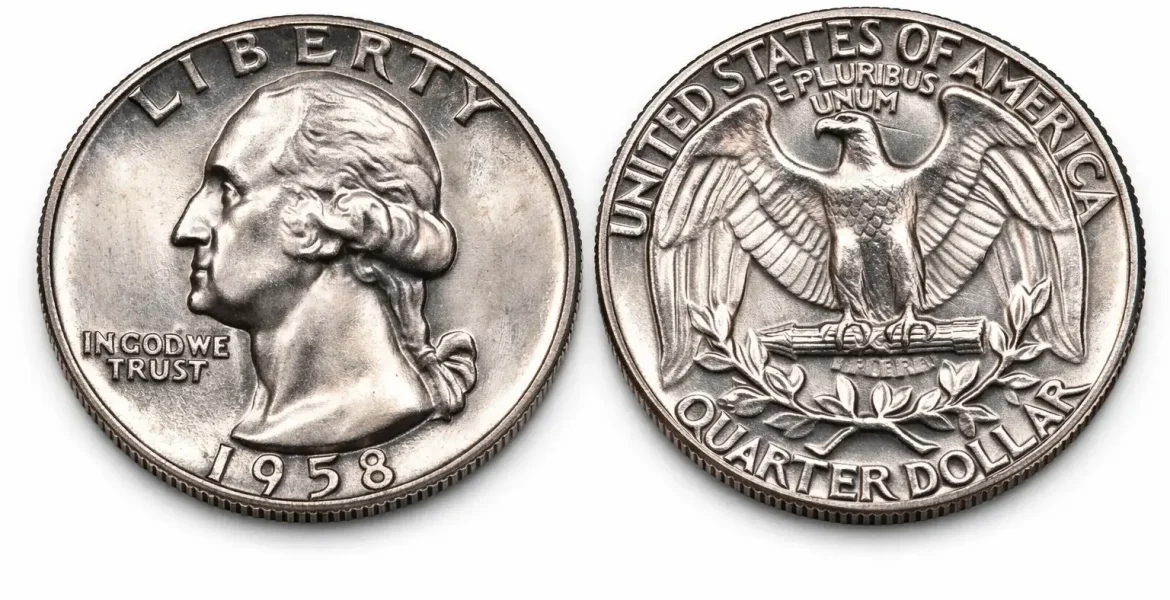
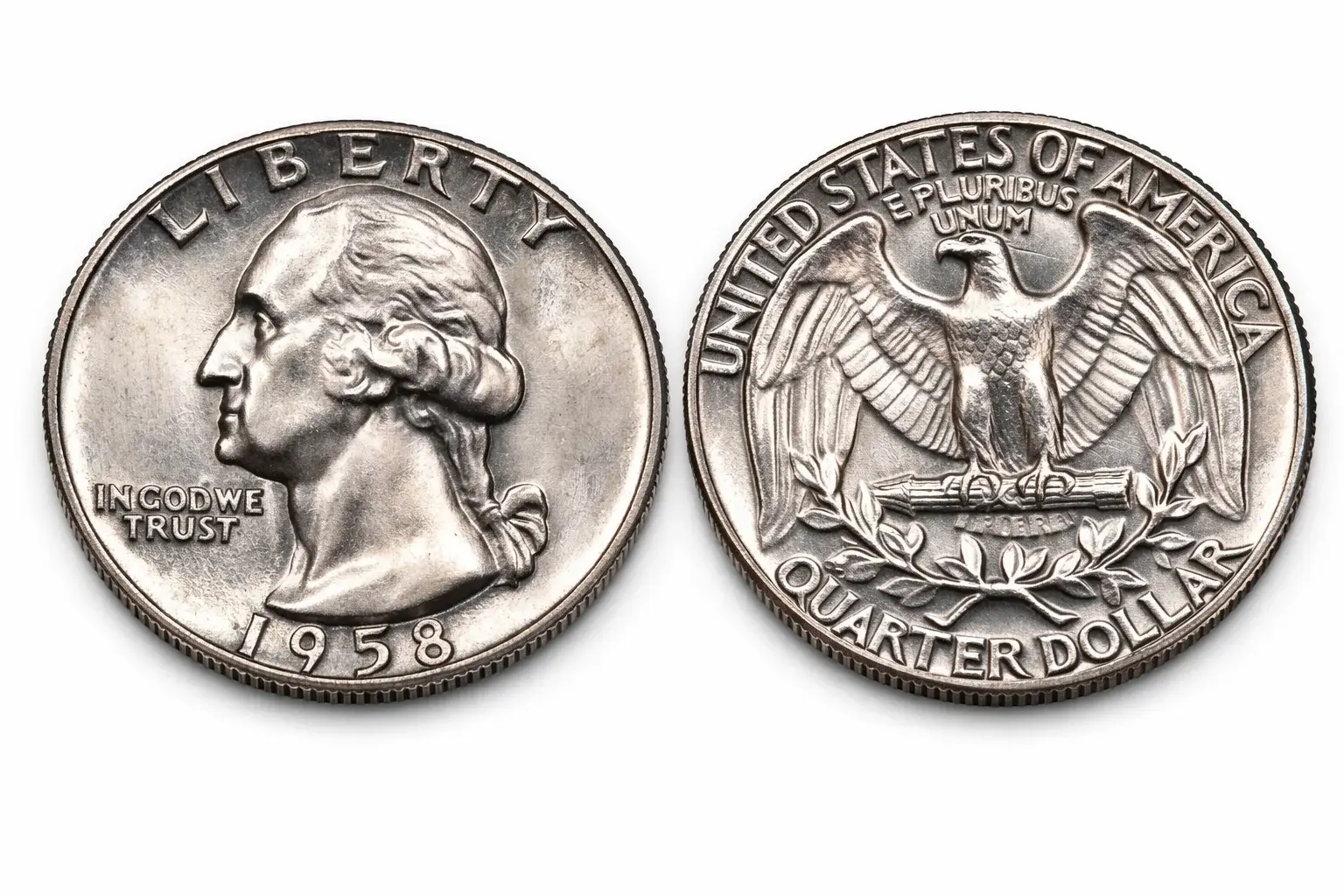
The 1958 quarter is a Washington quarter designed by John Flanagan. It uses the standard pre-1965 silver composition: 90% silver and 10% copper. In 1958, collectors could separate the issue into three main versions: Philadelphia business strike, Denver business strike, and Philadelphia proof. Other parameters, please check in the table below.
| Feature | 1958 Silver Quarter |
| Coin type | Washington quarter |
| Designer | John Flanagan |
| Composition | 90% silver, 10% copper |
| Weight | 6.30 grams |
| Diameter | 24.30 mm |
| Edge | Reeded |
| Main versions | 1958, 1958-D, 1958 Proof |
These shared specs matter because they show what does not explain the price. The metal is the same across the three main versions. The market split comes later. It comes from mintage, preservation, strike quality, proof status, and special designations such as CAM, DCAM, or Type B Reverse.
At this stage, the coin scanner app can help: it does not confirm the grade of the coin, but offers the basic type, compares the look of a business strike with a proof, and keeps the main specs in view before a buyer treats every 1958 quarter as the same coin. That helps most when a prooflike business strike or a Type B reverse starts to look more important than an ordinary silver piece.
The Silver Floor: When the Metal Still Matters
A 1958 quarter has one strong advantage over later clad issues. It still contains silver. That creates a base level of value even when the coin is worn and ordinary. Circulated 1958 quarters are in the mid-teen dollar range, with 1958 at about $17.50 to $20 and 1958-D at about $14.75 to $17.25 as of early 2026. That range reflects the silver floor more than any collector premium.
This is where metal matters most. In low grades, the market is not paying for rarity. It is paying for a silver Washington quarter that still has normal demand. A piece with honest wear, average surfaces, and no special variety usually stays close to that metal-driven level. That is true for many coins from the 1940s through the early 1960s, and 1958 fits that pattern well.
A simple rule works here:
- Circulated silver quarter = mostly metal logic;
- Lower uncirculated coin = some collector premium;
- Top-grade coin = collector market;
- Proof cameo coin = separate collector market.
That rule is not exact, but it is useful. It keeps a collector from paying MS money for a coin that still trades like silver.
When the Metal Stops Being the Main Factor
The silver content does not disappear. It just stops leading the conversation. Once the coin reaches a stronger Mint State or better proof quality, the market starts to reward preservation, eye appeal, and scarcity in top grade.
Those prices are far above any bullion floor. That is the core lesson of the date. Metal explains the bottom. Quality explains the top. A collector who understands that will read the market much more accurately.
The Three Main 1958 Quarter Markets
The date splits into three practical markets. They should not be mixed.
1958 Philadelphia
The Philadelphia business strike has the lowest mintage of the group at 6,360,000 pieces. That sounds scarce. Yet PCGS notes that the coin is still available in Gem because many rolls were saved when the coins were new. So, low mintage does not automatically make this version expensive in the mid-range Mint State grades.
1958-D
The Denver coin has a much larger mintage of 78,124,900 pieces. In lower grades, it is the most available version. But the high-end market changes the picture. The top-grade record is stronger than the Philadelphia record, which shows that upper-level preservation can outweigh the large mintage.
1958 Proof
The proof quarter belongs to a separate lane. It was made for collectors, not circulation. The mintage was 875,652 pieces. The coin is still silver, but metal is not the main story here. Surface quality, hairlines, frost, contrast, and certification matter more. That is why ordinary proofs remain accessible while top CAM and DCAM pieces move much higher.
| Version | Why collectors buy it | What matters most | Where the price moves fastest |
| 1958 Philadelphia | lower mintage business strike | grade, luster, eye appeal | upper Gem levels |
| 1958-D | common silver quarter with strong top-end potential | grade, clean surfaces | top-pop Mint State |
| 1958 Proof | collector issue | hairlines, contrast, preservation | CAM and DCAM tiers |
That table shows the practical split. A worn 1958 quarter is still a silver quarter. A high-end proof is something else.
1958 Silver Quarter Value Overview
The broad price picture becomes clearer when the versions are separated.
| Type | Typical lower-range value | What pushes it higher | Top-end path |
| 1958 circulated | about $17.50–$20 | better grade | high Mint State |
| 1958-D circulated | about $14.75–$17.25 | better grade | high Mint State |
| 1958 Mint State | above the silver floor | luster, marks, strong grade | MS67–MS68 |
| 1958-D Mint State | above the silver floor | stronger preservation | MS67–MS68 |
| 1958 Proof | modest collector premium | cleaner fields | PR68–PR69 |
| 1958 CAM / DCAM | clear premium tier | contrast and preservation | PR69 CAM / DCAM |
Ordinary circulated coins stay close to their silver base. Mint State coins begin to move once the grade is clearly above average. Proof coins move differently because contrast and finish matter much more there than metal alone.
Grade: The Real Divider Above the Silver Floor
Grade is where the collector premium begins. A worn coin remains a silver piece first. An attractive, uncirculated coin becomes a collector coin.
The business strike progression is simple:
- Circulated: mostly silver-driven;
- About Uncirculated to lower Mint State: modest premium;
- MS65 to MS66: stronger collector attention;
- MS67 and above: much harder market;
- Top-pop coins: auction-driven.
This matters most on dates like 1958. The year is not rare in a dramatic way, but the best survivors are still hard enough to matter. A collector pays more for quality, not for the calendar date by itself.
Proof Coins: When Eye Appeal Beats Silver
The proof issue makes the main point of this article very clear. Metal matters less here because eye appeal matters more.
An ordinary 1958 proof can stay affordable. PCGS shows the standard proof auction record at $690. GreatCollections reports proof CAMEO sales ranging from $9 to $439 over the last 16 years. Those are not bullion prices. They are collector prices shaped by contrast, surfaces, and grade.
The better the contrast, the stronger the price path.
| Proof category | What collectors look for | Market effect |
| Proof | clean mirrors, a few hairlines | modest premium |
| CAM | visible frost-to-field contrast | stronger demand |
| DCAM | bold contrast and top preservation | highest premiums |
The silver is the same. The premium is not.
The Overlooked Detail: Type B Reverse
The 1958 quarter has one more angle that can move the market away from silver logic. It is the Type B Reverse, cataloged as FS-901.
Some 1958 Philadelphia coins struck from retired proof dies show the Type B reverse, with the letters ES in STATES clearly separated and E PLURIBUS UNUM in higher relief. PCGS treats it as a recognized major variety and lists an auction record of $4,800 for an MS67+ example.
This is exactly the kind of detail that changes a coin from “just a silver quarter” into a more serious collector piece. It does not apply to every 1958 quarter. It does show why the metal stops being the whole story once varieties enter the picture.
What Collectors Should Check First
A simple routine keeps this date easy to judge:
- Confirm the version: 1958, 1958-D, or proof.
- Check the surfaces and luster.
- Decide if the coin is still trading on silver or is already in collector quality.
- On proof coins, check the contrast.
- On Philadelphia coins, look for the Type B reverse.
- Judge the grade before paying a premium.
That routine works because the market for 1958 quarters is logical. The base value comes from silver. The added value comes from preservation, proof quality, and variety.
Final Verdict: When the Metal Matters and When It Does Not
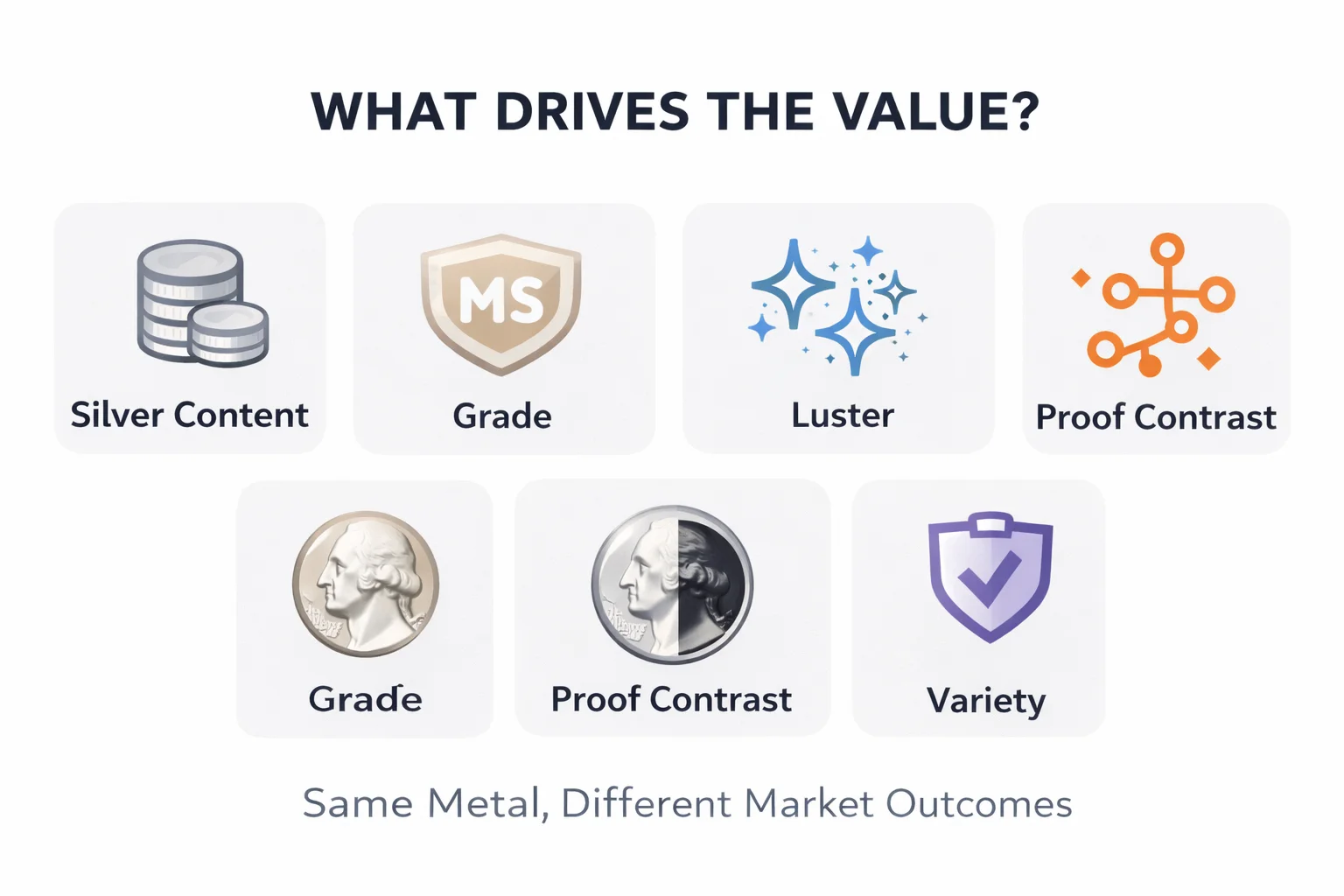
The metal matters most on ordinary circulated coins. That is where the silver floor does the heavy lifting. The metal matters less on stronger Mint State coins, where grade and eye appeal begin to take over. It matters even less on proof CAM and DCAM pieces, where contrast and preservation can push the price far beyond melt value. Type B Reverse coins show another way the market can leave silver logic behind.
That is the real answer to the 1958 silver quarter. The coin starts as bullion-backed silver. Try the free coin identifier app to quickly check the value ranges. What is more, the Coin ID Scanner app can help with collection management and answering questions before the closer grading step begins.
- 1958 Silver Quarter Value: When the Metal Matters and When It Does Not
 The 1958 silver quarter value starts with silver, but it does not end there. Every 1958 Washington quarter is a 90% silver coin. That gives
 - Plan a Coin Collection Budget: Reliable and Long-Term Oriented
 Coin collecting remains one of the most affordable hobbies, even if it doesn’t seem that way on the first glance. The key is smart budget
 - How to Detect a Valuable Penny in Your Collection: Guide for Hobbyists
 At first glance, a penny may seem like the least exciting coin in your pocket — a humble piece of copper (or zinc) often overlooked
 - Organizing a Family Trip without Going Crazy: Top Life Hacks
 Planning a family trip should spark excitement, not migraines. But when you’re juggling different interests, dietary needs, nap schedules, finding out ‘does GPS work without
 - Go Vintage: Top Tips on Flea Markets Exploration
 Flea markets are more than just open-air bazaars—they’re living archives of style, craftsmanship, and stories waiting to be uncovered. Whether you’re searching for a mid-century
 - The Power of Accessories: Elevating Every Outfit
 In the world of fashion, accessories play a pivotal role in transforming an outfit from ordinary to extraordinary. They have the power to convey your